Why Your Step Count Goal Isn't Making You Walk More
The 10,000-step target was invented to sell pedometers in 1965. The number stuck. The behavior didn't.

The 10,000-step target didn't come from a doctor. It came from a pedometer.
In 1965, a Japanese company called Yamasa launched a walking device timed to the post-Olympic fitness boom in Tokyo. They named it the Manpo-kei, which translates, literally, as "10,000 steps meter."

The name was a marketing decision. The number was round, memorable, and had no particular basis in exercise science. It spread anyway, got absorbed into public health messaging over the following decades, and eventually became the default goal embedded in every fitness app, every smartwatch, every corporate wellness program.
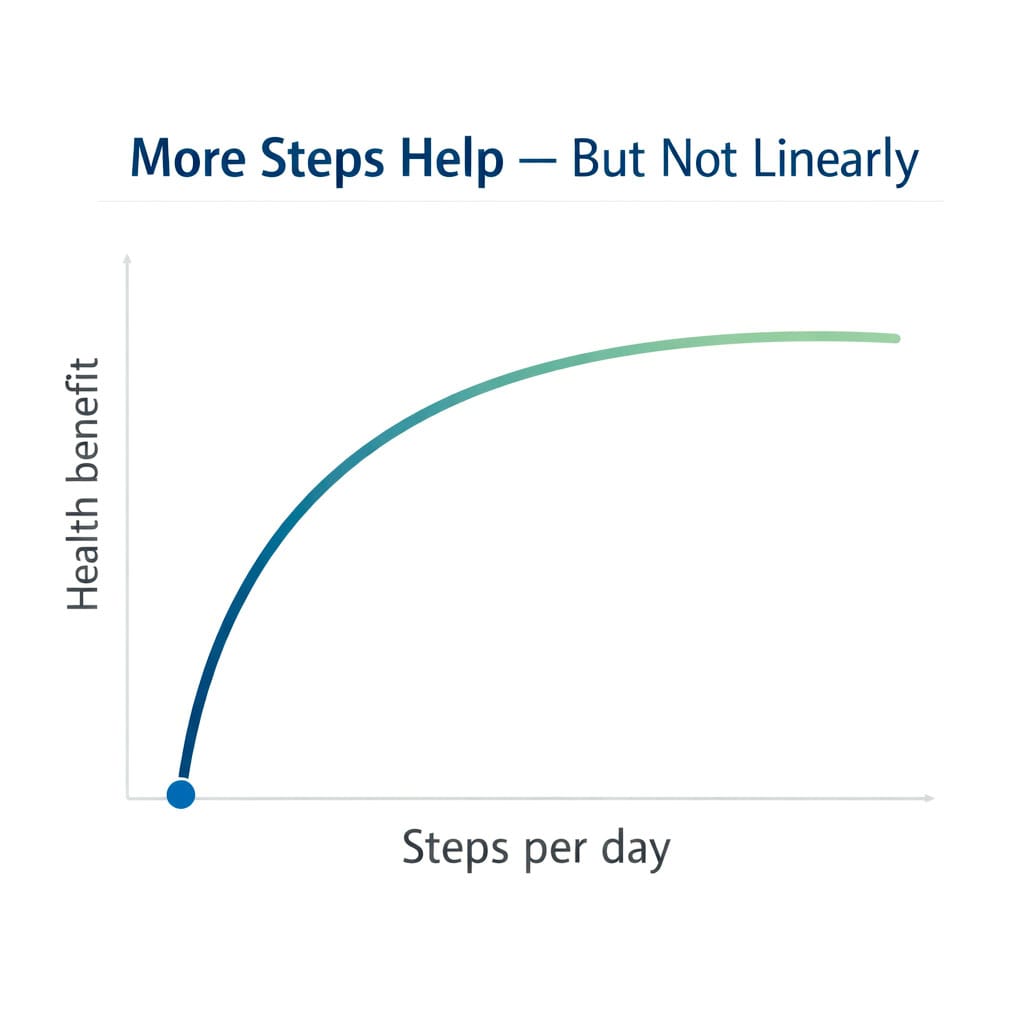
A 2019 Harvard study tracked 16,741 women and found that mortality risk dropped significantly at around 4,400 steps per day, with the benefit curve flattening well before 10,000.
A separate JAMA Internal Medicine paper found similar plateau effects. The specific number — 10,000 — has never been shown to be uniquely meaningful. It just happens to be what we all agreed on without really agreeing.
This is worth knowing, but it is not actually the problem.

The problem is the framework, not the number.
A daily step target turns walking into a binary event. You either hit it or you don't. On days when you do, the goal has been accomplished — there is no reason built into the system to do more. On days when you are clearly not going to hit it by 9 pm, the goal has been failed — and psychologically, a failed goal is often more demotivating than no goal at all. Research on what's called the "what-the-hell effect" in habit psychology has documented this pattern repeatedly: once people feel they've broken a rule, they tend to abandon it entirely rather than partially recover.
So the app that's supposed to make you walk more is, for a large portion of its users, producing either complacency or resignation — depending entirely on what kind of day they're having.
There's a second problem. Daily step counts are volatile in ways that have nothing to do with your actual movement habits. A hiking trip on Saturday inflates Sunday's mood and distorts your self-perception for a week. A day spent traveling — airports, dragging luggage, standing in queues — can produce 14,000 steps that feel nothing like a "fit day." A rainy Tuesday where you genuinely couldn't get outside tanks your number. These fluctuations are real, but they are not the signal you should be optimizing for. They are noise.
What consistency actually looks like
The question worth asking isn't "did I hit 10,000 steps today?" It's "what does my movement look like across the last two weeks?"
That shift in time horizon changes everything about how you relate to a missed day. If your rolling 14-day average is 8,400 steps, one rest day at 3,000 barely moves it. One strong week of 10,000+ daily lifts it meaningfully. The number stops being a daily verdict and starts being a portrait — something stable enough to tell you who you actually are as a mover, not just how yesterday went.
This is why GFN is built around ADS — Average Daily Steps over a rolling 14-day window — rather than a daily target. It is the single number in the app, the metric every leaderboard ranks by, and the number your profile leads with. Not because 14 days is a magic window, but because a two-week average smooths out the noise that makes daily tracking so emotionally volatile, while staying short enough to actually respond to behavior change. Walk more consistently for a week and your ADS climbs. Take a few lazy days and it drops — gradually, honestly, without drama.
This also changes what competition means. Ranking people against each other on daily step counts rewards whoever had the best Saturday. Ranking them on ADS rewards whoever walks more, more often. That is a more interesting competition and a more honest one.
Why this matters if you've tried fitness apps before and stopped
If you've installed three or four step-tracking apps over the years and quietly deleted each one after a few weeks, it is worth asking what actually caused you to stop. In most cases, it wasn't lack of motivation. It was a feedback loop that couldn't survive contact with ordinary life — a streak that broke during a work trip, a weekly target that felt pointless once the novelty wore off, a leaderboard you fell off and couldn't be bothered to claw back up.
A rolling average doesn't break. It bends. A bad week lowers your ADS; a good week lifts it. There is always a reason to walk more today because today's steps are always relevant to the number that represents you. That is a fundamentally different behavioral structure than a target you either hit or don't.
The 10,000-step goal isn't useless. Any number that gets someone moving is better than no number at all. But if it's not working for you, the goal itself might not be the problem. The time horizon might be.